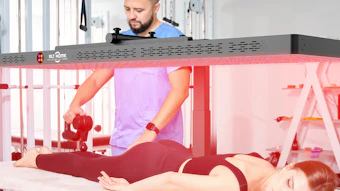
By embedding specific LED wavelengths directly into the applicator head, Nuon enables brands to activate biological responses (such as collagen stimulation via Red light or anti-bacterial action via Blue light) at the precise moment the formula is being spread.
Nuon
For much of the beauty industry’s modern history, innovation followed a linear and somewhat fragmented path. New ingredients emerged from white labs, formulations became increasingly complex with multi-layered encapsulation, and marketing efficacy claims grew more sophisticated. Packaging, by contrast, was largely relegated to a supporting role—a silent vessel tasked with protecting chemical stability, supporting dosage through vacuum pumps, and delivering the crucial “shelf appeal” necessary for conversion.
However, as we move through 2026, that historical separation between “the juice” and “the bottle” no longer reflects how skin care performance is judged by the market or the consumer.
According to recent beauty megatrend reports from leading firms, we have entered the “Era of Precision Delivery.” Consumers are pivoting away from “ingredient chasing”—the era of high-percentage actives—and moving toward “outcome optimization.” As users become more digitally native and biologically informed, brands are being evaluated not only on the theoretical potency of what a product contains but on how reliably that potency translates into physiological change in the unoptimized environment of everyday life. This shift is prompting a broader industry reassessment: efficacy is no longer defined solely by the chemistry in the bottle, but by the physics of how that formula is delivered to the skin.
The Efficacy Gap: From Laboratory Proof to Real-World Results
As we move through 2026, that historical separation between “the juice” and “the bottle” no longer reflects how skin care performance is judged by the market or the consumer.Nuon
Clinical testing remains the gold standard for validation, yet a growing tension exists between the lab and the vanity. In a controlled clinical environment, products are applied by trained professionals or under strict supervision. Application pressure is standardized, timing is precise, and the skin state is often pre-conditioned for maximum receptivity.
The “Real-World” consumer experience is the antithesis of this control. Application varies wildly from person to person and even from day to day. Pressure is inconsistent; contact time is often truncated due to morning rushes; and coverage is frequently uneven, leaving “hot spots” of product and areas of total neglect.
As Nuon Medical highlights in its 2026 Technical Insights series, even the most sophisticated formulas underperform when delivery relies entirely on unguided user technique. Historically, brands attempted to address this via formulation alone—introducing higher active concentrations, penetration enhancers, or complex solvents. While effective to a degree, these are “passive” solutions to an “active” problem. What has become the industry consensus in 2026 is that efficacy is a physio-chemical synergy. Packaging is no longer a container; it is a functional interface that orchestrates physical interaction, thermal preparation, and habit formation to ensure every drop of formula reaches its intended biological target.
The Intelligence Layer: The Rise of Skin Diagnostics
Phototherapy has transitioned from a standalone, time-consuming device to an integrated step in the primary delivery system. Nuon
The most significant leap in 2026 packaging is the transition from “dumb” dispensers to “sensory” systems. At the heart of this revolution is Skin Diagnostics. Modern packaging now effectively possesses its own “senses,” allowing the device to act as a bridge between the user’s immediate biological state and the product’s delivery mechanism.
Nuon Medical has pioneered the integration of medical-grade sensors into primary packaging, enabling real-time diagnostics of hydration levels, sebum production, pH balance, and even cumulative UV exposure. This data is no longer just for a smartphone app; it is used to actively guide the application.
For example, a system equipped with Skin Diagnostics can detect a compromised skin barrier or localized dehydration. Instead of the user blindly applying a standard pump of product, the packaging provides haptic or visual feedback to adjust the dosage, or it may modulate the integrated delivery technology—such as adjusting the intensity of the LED or the frequency of the micro-vibration—to match the skin’s receptivity at that exact moment. This transforms the skincare routine from a static habit into a dynamic, personalized medical-grade treatment.
The Functional Architecture: Engineering the Moment of Contact
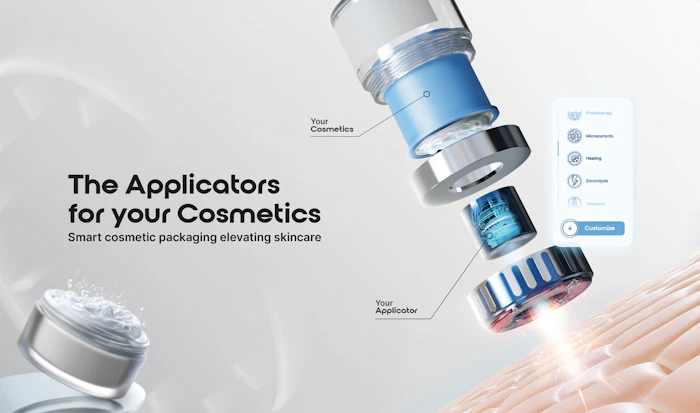
When we discuss “Functional Packaging” in 2026, we are referring to the specific architectures that intervene at the point where formula meets skin. Nuon Medical’s research and development have identified five core pillars of delivery technology that are currently redefining the premium skincare category:
1. Integrated Phototherapy (LED)
Phototherapy has transitioned from a standalone, time-consuming device to an integrated step in the primary delivery system. By embedding specific LED wavelengths directly into the applicator head, Nuon enables brands to activate biological responses (such as collagen stimulation via Red light or anti-bacterial action via Blue light) at the precise moment the formula is being spread. This “Integrated Phototherapy” creates a synergistic effect: the light prepares the skin cells to receive the actives, while the formula provides the necessary building blocks for the light-triggered repair.
2. Calibrated Needling Systems
The barrier function of the stratum corneum is the skincare chemist’s greatest adversary. In 2026, we have moved beyond “hopeful absorption” toward “engineered penetration.” Specialized applicator architectures now utilize precision-calibrated micro-needling elements. Unlike traditional rollers, these are integrated into the dispensing head to create temporary, painless micro-channels in the skin’s surface. By calibrating the depth and density of these channels, brands can ensure that high-molecular-weight actives—which would otherwise sit on the surface—are delivered exactly where they can trigger cellular responses.
3. Pulsed Electromagnetic Field (PEMF) & Micro-Vibration
One of the most exciting frontiers in 2026 is the use of PEMF in daily packaging. PEMF technology, once restricted to medical recovery clinics, is used to boost cellular energy (ATP) and enhance local circulation. When integrated into an applicator, it works alongside high-frequency micro-vibrations. This does more than just feel “premium”; it creates a kinetic environment that reduces the surface tension of the formula and ensures even distribution across the undulating surface of the skin, preventing the “manual rubbing” that often leads to product pilling or irritation.
4. Thermal Management
Temperature is a critical, yet often overlooked, variable in efficacy. Nuon’s thermal architectures allow for near-instantaneous heating or cooling of the applicator surface. Controlled warmth (Thermal Priming) increases the fluidity of skin lipids, effectively “opening” the door for deeper ingredient penetration. Conversely, precision cooling (Cryo-Delivery) is utilized for targeted treatments—such as eye contouring or anti-inflammatory serums—to constrict blood vessels and lock in actives, providing immediate sensory and physiological results.
5. Guided Motion Architectures
Finally, the physical shape of the applicator itself has evolved. Ergonomic “Guided Motion” heads follow the complex contours of the face—the orbital bone, the jawline, and the nasolabial folds. These shapes are engineered to provide “Haptic Guidance,” essentially teaching the user the correct lymphatic drainage paths or muscle-lifting movements through the physical feedback of the device.
Packaging Moves from Passive to Functional: The Business Case
For brand owners and B2B stakeholders, the move toward functional packaging is not merely a technical flex; it is a strategic necessity. In a market saturated with “clean beauty” and “science-backed” claims, the point of differentiation has shifted.Nuon
For brand owners and B2B stakeholders, the move toward functional packaging is not merely a technical flex; it is a strategic necessity. In a market saturated with “clean beauty” and “science-backed” claims, the point of differentiation has shifted.
2026 Trend report on Beauty & Personal Care highlights that “Frictionless Tech” is now the number one demand for the high-net-worth consumer. In previous years, the “Beauty Tech” boom led to an influx of standalone devices that eventually ended up in the “gadget graveyard”—drawers full of expensive tools that consumers were too busy to use.
The 2026 winners are brands that embed this technology directly into the primary packaging. This integrated approach solves the “User Adherence” problem. When the Skin Diagnostics and the Phototherapy are part of the bottle itself, the consumer doesn’t have to change their routine. They simply use the product as they always have, but with a 10x increase in delivery efficiency. For a brand, this means faster visible results, higher repurchase rates, and a significantly higher barrier to entry for competitors who are still relying on basic dropper bottles.
Sustainability in the High-Tech Era: The Modular Revolution
At the world’s leading skincare conglomerates, the “Packaging Department” is no longer at the end of the hallway, waiting for the chemists to finish the formula.Nuon
A common critique of tech-integrated packaging is its environmental impact. How can a brand justify electronics and sensors in a world focused on sustainability? In 2026, the answer is Modular Design.
Nuon Medical has been a vocal advocate for the “Core and Cartridge” model. In this architecture, the “Core” (containing the Skin Diagnostics sensors, the PEMF emitters, and the battery) is a durable, high-quality component designed to last for years. The skincare formula is housed in a lightweight, recyclable “Cartridge” that clicks into the Core.
This creates a powerful circular economy:
Reduction of Electronic Waste: The expensive tech stays with the consumer.
Refill Loyalty: The consumer is “locked in” to the brand’s ecosystem through the durable device.
Precision Dosing: Because the system ensures 100% of the formula is delivered effectively, brands can actually reduce the total volume of product needed, further lowering the carbon footprint associated with shipping and raw material extraction.
In 2026, sustainability is no longer just about the material of the bottle—it is about the efficiency of the system. A product that is 50% more effective allows for a 50% reduction in total consumption over time.
Organizational Shift: Packaging as an Integrated Development Tool
The future of beauty isn’t just in what we apply; it’s in how we apply it.Nuon
Perhaps the most significant change we see in 2026 is organizational. At the world’s leading skincare conglomerates, the “Packaging Department” is no longer at the end of the hallway, waiting for the chemists to finish the formula.
Delivery must be considered alongside formulation, clinical testing, and user experience from day one. This requires a “Squad” approach: formulation scientists, packaging engineers, skin biologists, and industrial designers working in a feedback loop. At Nuon Medical, we facilitate this by acting as the “Technical Bridge.” We help brands align the viscosity of their serum with the frequency of our micro-vibration systems, ensuring that the two work in harmony rather than at cross-purposes.
When delivery and formula evolve together, the result is a product that is easier to validate through clinical trials because the variables of human application have been minimized. This leads to cleaner data, more robust claims, and a faster path to market.
Conclusion: Where Performance Is Decided
As we look toward the remainder of 2026 and beyond, the definition of “premium skincare” has been irrevocably altered. Efficacy is no longer a static laboratory result; it is a dynamic event that occurs at the moment of application. It is shaped by Skin Diagnostics, optimized by energy and temperature, and sustained by habit-forming ergonomic design.
Packaging, once the “silent component,” has become the most vocal advocate for the formula’s success. For brands navigating an increasingly outcome-driven market, the gap between promise and performance is closing. By treating packaging as a functional interface rather than a passive container, Nuon Medical and its partners are ensuring that skincare efficacy is not just a marketing claim—it is a repeatable, tangible, and high-tech experience.
The future of beauty isn’t just in what we apply; it’s in how we apply it.
About Nuon Medical
Nuon Medical is a global B2B leader at the intersection of Medtech and Skincare. With a focus on tech-integrated delivery systems, Nuon provides brands with the “Functional Architectures” required to dominate the premium market. From Skin Diagnostics and LED integration to PEMF and thermal management, Nuon’s mission is to enhance skincare efficacy precisely where the formula meets the skin.
The above paid-for content was produced by and posted on behalf of the Sponsor. Content provided is generated solely by the Sponsor or its affiliates, and it is the Sponsor’s responsibility for the accuracy, completeness and validity of all information included. MedEsthetics takes steps to ensure that you will not confuse sponsored content with content produced by MedEsthetics and governed by its editorial policy.
 As we move through 2026, that historical separation between “the juice” and “the bottle” no longer reflects how skin care performance is judged by the market or the consumer.Nuon
 Phototherapy has transitioned from a standalone, time-consuming device to an integrated step in the primary delivery system. Nuon
 Phototherapy has transitioned from a standalone, time-consuming device to an integrated step in the primary delivery system. Nuon

 For brand owners and B2B stakeholders, the move toward functional packaging is not merely a technical flex; it is a strategic necessity. In a market saturated with “clean beauty” and “science-backed” claims, the point of differentiation has shifted.Nuon
 At the world’s leading skincare conglomerates, the “Packaging Department” is no longer at the end of the hallway, waiting for the chemists to finish the formula.Nuon
 The future of beauty isn’t just in what we apply; it’s in how we apply it.Nuon