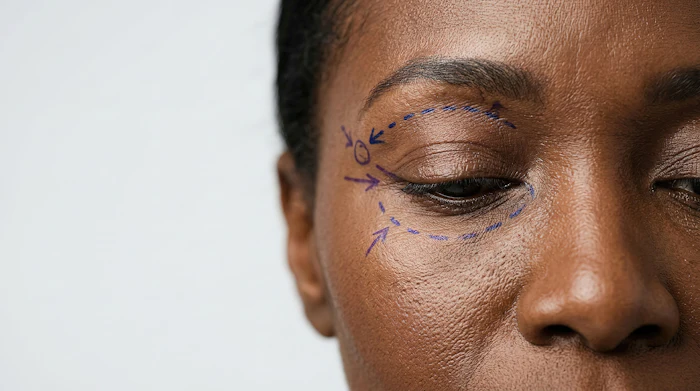
Blepharoplasty is evolving beyond the traditional approach of removing excess skin and fat.
Today, surgeons are increasingly focused on preserving or restoring volume, addressing the relationship between the eyelids, brow and surrounding structures, and tailoring techniques to each patient’s anatomy and aesthetic goals.
Related: PRP/FM Options for Under-Eye Rejuvenation
Additive blepharoplasty, fat grafting, nanofat, regenerative modalities and advanced imaging are becoming part of a broader conversation around how to achieve natural-looking, long-term results while avoiding an overly hollow or operated appearance.
To explore how these techniques are being applied in practice, MedEsthetics spoke with Dr. David Lieberman, double board-certified plastic surgeon and medical director at L&P Aesthetics, about his approach to blepharoplasty, including volume restoration, nanofat, regenerative treatments, preoperative imaging, laser resurfacing and the changing demographics of eyelid surgery patients.
Do you use additive blepharoplasty, combining skin removal with fat grafting? If so, what does that combination let you achieve that skin removal alone doesn't?
A youthful presentation of the eyes is not just about removing age-related change. Treating the volume loss due to soft tissue and bone change is essential. This is always true for the lower eyelid complex but also applies to the upper eyelids. Descent of the brow complex and volume change at the junction of the brow, and the eyelid are central components of age-related change. Neglecting volume issues in the upper eyelid complex can lead to a skeletonized and hollow appearance, even aging the appearance. To comprehensively address the upper eyelid complex we typically combine a brow reshaping procedure (here the youthful relationship between the soft tissue of the brow and the orbital bone is restored), fat grafting around the brow and in the hollow between the brow and the eyelid, and upper blepharoplasty. In our upper blepharoplasty, while excess skin is removed, the muscle and youthful fatty volume is preserved by design. When the fat pad by the nose is prominent, this is contoured appropriately.
When you use autologous fat rich in stem cells for that grafting, what changes for the patient in terms of natural volume, fine lines, and skin quality over time?
The biggest thing we see over time is very natural volume restoration. Once the transferred fat has settled, the portion that survives integrates into the surrounding tissue and can provide long-lasting correction. Patients may also see some softening of fine lines and improvement in the overall appearance and quality of their skin, but we consider those secondary benefits.
Do you use nano lipofilling for dark circles or under eye concerns? If so, why has it become a go to for that specifically?
Fat grafting in any area is a multi-level procedure. For the lower eyelids and the lid-cheek junction, our primary goal is to restore the deeper volume loss due to bone changes and soft tissue loss. Here we use structural fat placed in very small aliquots (amounts) directly on the bone. This is precise and strategic to maximize survival, optimize contour, and minimize any change of irregularity. Occasionally, we also use nano-fat to focus on texture changes and superficial volume changes. This is especially powerful when we are simultaneously doing laser resurfacing as it helps with healing and the long-term outcome.
How does that regenerative effect show up for patients? Are we talking pigmentation, radiance, both?
It can be a combination of both. Patients may notice that the under-eye skin looks brighter and more even in tone, with improvements in texture and fine lines that give the area an overall healthier appearance.
Do you incorporate PRP, exosomes, or nanofat into your practice? If so, where does each fit and what is it doing that the others aren't?
We currently use nanofat, but we don't incorporate PRP or exosomes into our surgical practice. Nanofat fits more naturally into our surgical approach because we can harvest the patient's own fat during a procedure and use it very selectively in areas where we're looking to improve fine lines, texture and overall skin quality without adding significant volume. We do use PRP during our brow reshaping and deep plane face lifting procedures to help boost the tissues for healing. We also use many of the regenerative modalities in our nonsurgical practice.
How do these regenerative additions change healing time or the durability of a result compared to surgery alone?
We don't necessarily look at regenerative modalities as a way to make the surgical result last longer. A case can be made that appropriate use of regenerative treatments can help with healing time frames and boost the cellular mechanisms to combat the aging process. The longevity of the result still comes primarily from the surgery itself (soft tissue repositioning/lifting, volumizing procedures). For us, nanofat is more about complementing that result by addressing skin quality, texture and color. Those changes can continue to become more apparent as the area heals, and the final surgical result settles.
Do you use imaging or visualization tools like Crisalix or VECTRA with patients before surgery? If so, what does that actually change about the consultation?
We use the Visia imaging prior to any deep resurfacing so we can demonstrate change and learn from our procedures as we continually work to optimize our protocols.
Why does that kind of preop planning matter for aligning a result with someone's actual anatomy and goals?
Preoperative imaging gives us another way to understand what a patient is seeing, what they hope to change and how that relates to their individual anatomy. It creates a much more specific conversation around proportions, asymmetries and realistic goals before we ever enter the operating room.
Do you perform laser blepharoplasty using CO2 or erbium lasers? If so, how does it compare on bleeding, swelling, and downtime versus traditional methods?
We don't use CO2 or erbium lasers to perform the blepharoplasty itself. Our surgical technique is still performed with traditional instruments, and we use laser resurfacing around the eyes as a complementary treatment. We have several laser modalities' that we adapt to a patient's skin type and expectations for healing and outcome.
Circle back to additive blepharoplasty. From a technique standpoint, how does combining skin removal with fat grafting change the outcome versus doing them separately?
Doing them together allows us to balance removal and restoration in the same procedure. That gives us greater control over the final contour and helps avoid an overly hollow appearance. We really treat the area as a whole rather than correcting excess skin and volume loss as two separate problems.
Are you familiar with or do you use Ziplyft? If so, what's the appeal of a sutureless, no stitches approach for patients?
We're familiar with Ziplyft, but it's not a technique we currently use in our practice. We understand the appeal of a sutureless approach from a patient perspective, however our priority is choosing the technique that gives us the greatest control and consistency for each patient's anatomy.
Are you seeing more men come in for eyelid surgery? What's driving that shift?
Yes, we're definitely seeing more men interested in eyelid surgery. One patient told us that the shift to Zoom and working remotely meant he was suddenly looking at his own face for hours a day, which made him more aware of changes to his face. More broadly, we think men are becoming increasingly comfortable seeking aesthetic treatments while still wanting results that are subtle and don't look obviously surgical.
What does that expanded patient base, beyond women in their 30s to 50s, mean for how you approach these consultations?
Our approach really hasn't changed because we've always treated these consultations as highly individualized. We're looking at the patient's anatomy, how they're aging, what specifically bothers them and what they hope to achieve, not their age or gender. As the patient base expands, that individualized approach becomes even more important because there simply isn't a one-size-fits-all procedure. No matter what procedure a patient is having in our practice, we know we are intervening at a certain point in their aesthetic journey. It is our responsibility to treat them as if we were taking care of them for their lifetime- making smart long-term decisions for that particular person.
Are younger patients starting to come in earlier for procedures like blepharoplasty in your practice?
Yes, we are seeing younger patients come in for blepharoplasty, but their motivations are often different from those of older patients. They may have genetically prominent under-eye bags, naturally heavy upper lids, or hollowness. We also believe the increased transparency around aesthetic surgery online has made younger patients more aware of their options and more comfortable exploring them.
If so, how do you frame early intervention for a younger patient who isn't dealing with obvious sagging yet? What are you actually preventing?
We don't typically frame blepharoplasty in younger patients as a preventative procedure. If there isn't significant age-related sagging yet, we're usually addressing an existing anatomical concern rather than trying to prevent something from developing later. The benefit of intervening earlier for the right patient is that we can often make a very targeted, conservative change while preserving as much of their natural anatomy as possible.