Christopher Surek, DO, FACS, didn’t set out to become an aesthetic plastic surgeon. His early interest in medicine was rooted in something far more reconstructive: the desire to help children born with cleft lip and palate.
“I just thought it was such a powerful operation,” he says. “Being able to restore a smile for a child and change the trajectory of their life—that’s what drew me in initially.”
Related: Smile Train Takes on Operations of Simulare Surgical Simulation Training Tool
But like many surgeons, his path evolved as his exposure to the field deepened. During training, two experiences shifted his focus toward aesthetics: seeing his first facelift and watching a transformation closer to home.
“When I saw my first facelift, I realized how impactful aesthetic surgery could be,” he says. “And then my wife had a procedure, and seeing that result firsthand really reinforced it. That’s when I knew this was the direction I wanted to go.”
Today, nearly a decade into practice, Surek has built a reputation as both a surgeon and an educator, with a practice centered on facial aesthetics, injectables and body contouring. His approach is rooted in precision and restraint with an emphasis on restoring rather than changing, which continues to resonate with a growing patient base.
Anatomy as the foundation
Surek’s reputation in aesthetics is closely tied to his work in anatomy, a focus that began early in his medical training.
“I’ve always gravitated toward anatomy, even before medical school,” he says. “And once I got the opportunity to do an anatomy fellowship, it was an easy decision because everything we do in aesthetics—surgical or non-surgical—is based on anatomy.”
During that fellowship, Surek spent a year dissecting cadavers and studying anatomical structures in detail, an experience he says continues to shape his work today.
“The more you dissect and understand anatomy, the better you become as a surgeon or injector,” he says. “Every contour, every shadow, every change we see in the face, it’s all anatomy.”
That foundation led naturally into teaching. Over time, Surek began working with mentors to explore facial anatomy in the context of injectables and aesthetic procedures, eventually co-authoring textbooks and becoming a frequent lecturer.
“I enjoy educating just as much as I enjoy operating,” he says. “Because the stronger the anatomical understanding across the field, the better care patients receive.”
In practice, that emphasis on anatomy translates into a highly individualized approach. Rather than applying a standard formula, Surek evaluates each patient based on what he describes as both chronological and anatomical age.
“Two patients might be the same age, but they can look very different based on how they’ve aged,” he says. “If you understand the anatomy and the aging process, you can tailor your approach to what that individual patient actually needs.”
Building a practice with intention
When Surek launched his practice in Kansas City, he made a decision that would shape its trajectory, to focus exclusively on aesthetics from the start.
“The traditional model was to take on a mix of reconstruction and general call while building your cosmetic practice,” he says. “But today, that approach makes it harder to establish yourself because everything is so specialized.”
Instead, Surek doubled down on aesthetic procedures, using injectables and resurfacing treatments as an entry point to build his surgical practice.
“The ability to build an injection practice and a resurfacing practice really feeds the surgical side,” he says. “But you have to commit to it fully. It’s not something you can do halfway.”
That commitment extended to how he marketed the practice. Rather than relying heavily on personality-driven content, Surek focused on showcasing results.
“I’ve always believed your work should speak for itself,” he says. “If patients like what they see in before-and-after photos, they’ll come in. That’s been the foundation of my growth.”
Pricing strategy also played a role, particularly in the early years.
“My goal early on was to operate on as many patients as possible, because each result becomes part of your reputation,” he says. “Word of mouth is still the most powerful driver of referrals in this field.”
Over time, that approach has led to steady growth. What began as a gradual buildup has accelerated in recent years as referrals have increased and the practice has become more established.
“The first few years, you’re really working to get patients in the door,” he says. “But if you stay consistent and deliver good results, you start to see that momentum build.”
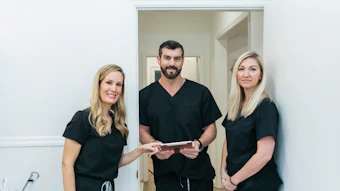
Today, Surek runs what he describes as a boutique-style practice, with a strong emphasis on patient experience and team alignment.
His team operates as an extension of that philosophy, with a dedicated clinical staff and patient coordinators guiding individuals through each stage of care. The practice also includes a private surgery center focused exclusively on cosmetic procedures, designed to provide a streamlined, highly controlled experience for patients.
A shift toward natural results
As aesthetic medicine has evolved, Surek has observed a clear change in what patients are looking for and what they want to avoid.
“I’ve seen a lot of trends come and go over the years,” he says. “But the consistent direction now is toward more natural results. Patients don’t want to look overdone or like they’ve had work done.”
That shift has influenced how he approaches both surgical and non-surgical treatments. Rather than addressing every concern at once, Surek focuses on prioritizing key areas.
“I usually ask patients to identify their top concerns and start there,” he says. “If you try to do too much at once, you risk losing that natural look.”
His philosophy is built around under-promising and over-delivering, a mindset that emphasizes subtle improvements over dramatic change.
“The goal is to restore, not alter,” he says. “You want patients to look like a better version of themselves, not a different person.”
That approach extends to how he evaluates new technologies and treatments. In an industry where innovation is constant, Surek takes a measured approach.
“There’s always something new being introduced, and it’s easy to get caught up in that,” he says. “But I think it’s important to make sure any treatment you offer actually delivers value for the patient.”
One area where he has seen meaningful advancement is in deep neck surgery, which addresses underlying structures to improve contour.
“That’s probably one of the biggest changes I’ve seen in recent years,” he says. “It allows us to achieve more refined and natural-looking results, particularly in the lower face and neck.”
A growing role for male patients
While Surek’s practice is built on a broad patient base, he has seen steady growth in male aesthetics.
“I would say about 25% of my practice is male patients, and that number has been gradually increasing,” he says.
That growth reflects broader changes in how men view aesthetic procedures. As stigma continues to decrease, more male patients are seeking treatments to maintain their appearance rather than dramatically change it.
“Men are dealing with the same aging process as women—volume loss, skin laxity, changes in the neck and eyes,” he says. “They just want to address it in a way that feels natural and not obvious.”
In many cases, the procedures are similar. Lower eyelid surgery and neck lifts are among the most common treatments in his male patient population, along with select body contouring procedures.
“The techniques don’t change dramatically between men and women,” he says. “It’s more about understanding the individual patient and making subtle adjustments.”
Where male patients tend to differ is in their priorities, particularly around discretion.
“They’re very focused on not looking operated on,” he says. “Scar placement and incision concealment become extremely important, because they don’t want anything that draws attention.”
That attention to detail requires both technical precision and a clear understanding of patient expectations.
“You have to approach each case with the goal of maintaining masculine features while still delivering a meaningful improvement,” he says.
As awareness continues to grow, Surek expects male aesthetics to remain an important part of the field’s evolution.
“The more people see natural, well-done results, the more comfortable they become exploring these options,” he says.
The road ahead
For Surek, the future of his practice is less about expansion and more about refinement, continuing to improve results, educate others and maintain a high level of patient care.
“I try to focus on being the best version of myself as a surgeon and as an educator,” he says. “If I can continue to deliver strong results and help advance the field through education, that’s what matters most.”
That mindset extends to how he works with patients, emphasizing communication and trust throughout the process.
“An informed patient is a better partner in their own care,” he says. “When they understand what you’re doing and why, it leads to better outcomes and a better overall experience.”
Away from the practice, Surek spends time with his family and stays active through golf and boating, a balance he says helps him stay focused and grounded in his work.
Surek remains grounded in the principles that have defined his career: a deep understanding of anatomy, a commitment to natural results and a focus on steady, deliberate growth.
“I love what I do, and I want to keep doing it at a high level,” he says. “If you stay focused on that, everything else tends to follow.”