Dr. Michelle Lee, a board-certified plastic surgeon and founder of PERK Plastic Surgery, offers an insider’s perspective on the evolving standard for facial rejuvenation— and why today’s most sophisticated facelift results may be the ones that never announce themselves.
In the following op-ed, Lee explores the shift toward natural-looking facial surgery, earlier intervention, deeper structural correction and a more longitudinal approach to aesthetic care.

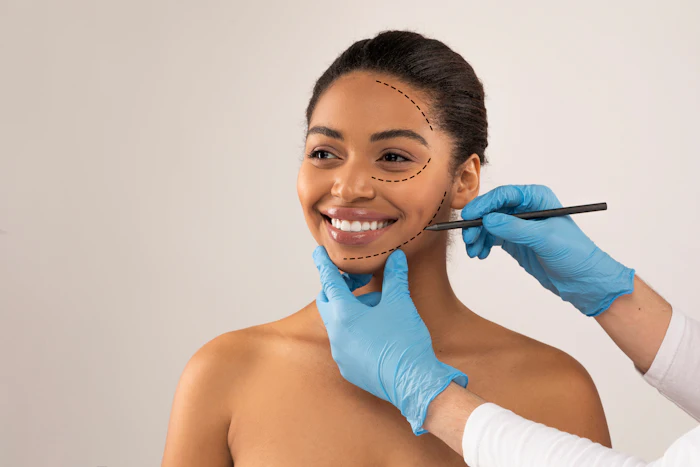
The most common thing patients say to me after a successful facelift is not "I look younger." It's "I look like myself again." That distinction is everything. Undetectable, to me, doesn't mean invisible intervention; it means the result is so congruent with who that person is that no one can locate the surgery. They just see a face that looks rested, vital, and alive.
Technically, it means incision lines disappear because there is no tension pulling at the skin, and contour is restored without the face feeling or looking tight. It is a face in harmony. That is the new standard of success, and frankly, it should always have been. We're simply now at a moment in medicine where the technique, the technology, and the cultural conversation have caught up to what patients have wanted all along.
Related: Pairing Skin Flooding and Facelifts
What I'm seeing in my practice is a fundamental shift in sophistication. Patients are arriving with reference photos not of celebrities, but of themselves: A vacation photo from ten years ago, a wedding picture, a screenshot of a candid where they 
They're also asking better questions. One unexpected driver of this shift is physician presence on social media.
When surgeons share educational content about anatomy, aging, and surgical technique, it raises the baseline of what patients understand before they ever walk into a consultation. Patients today know what a facelift can and cannot do. They understand that surgery addresses structure, but skin quality requires ongoing care. They understand volume replacement but can understand the consequences of too much filler. They want to understand the anatomy behind the aging they're seeing, and they can distinguish between structural changes and those driven by volume loss or skin quality. That kind of patient engagement tells me the conversation has matured. We're no longer talking about surface corrections. We're talking about biological age versus chronological age and patients understand the difference.
Related: Kao Finds the True ‘Biological Age’ of Skin
One of the most meaningful shifts in my practice is that patients are coming in earlier, and that's producing the most natural results I've ever achieved. When I see someone in their forties before significant structural changes have set in, I'm working with tissue that still has elasticity, vascularity, and regenerative capacity. I'm making smaller moves with longer lasting impact. We address early jowling, repositioning soft tissue at a point when the face's underlying architecture is still largely intact. The result looks natural because it is natural. We're not reversing a decade of change; we're maintaining a trajectory.
Technology has also expanded what's possible in terms of both precision and recovery. Imaging tools that let me assess soft tissue in three dimensions, regenerative adjuncts like fat grafting that bring living biology rather than inert filler to volume restoration, and refined anesthesia protocols that allow faster recovery.
Deep-plane facelift techniques that restore the face by releasing retaining ligaments.
90% of our patients undergo deep sedation anesthesia for facelift which is a lighter anesthesia than endotracheal intubation. Advanced postoperative protocols such as hyperbaric oxygen treatments allow for faster healing. All of these contribute to outcomes that are cleaner, more individualized, and less disruptive. Less trauma to tissue means less inflammation, less inflammation means faster healing, and faster healing means the result resolves beautifully rather than through a prolonged and visible recovery. The window between intervention and invisibility has narrowed dramatically, and that matters enormously to the modern patient.
What the best facial surgery actually requires is restraint. The single dramatic intervention, the transformative "before and after," has largely given way to a more nuanced approach: a layered, longitudinal approach that respects the face as a system. I think of it in decades. What I do today has to hold up ten years from now. That means addressing the deep structural layers where aging actually begins, not just the surface. A facelift that only tightens skin creates a face that will re-age asymmetrically. A deep plane approach that repositions the underlying SMAS and soft tissue creates a foundation that lasts and moves naturally, which is the thing people notice most when something has been done poorly.

Facial surgery is heading toward biology, toward longevity, toward results that are measured not by how much was changed but by how well the face holds its story. It's not about looking thirty when you're fifty. It's about looking like the healthiest, most vital version of yourself at every decade. My practice philosophy has always been: I treat now, I think in decades. That's not a slogan. It's a framework for how I believe this specialty should operate and where I believe it's finally, meaningfully headed.