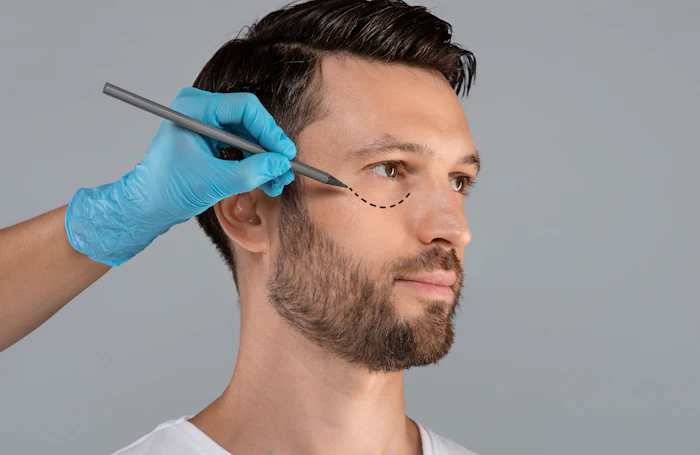
In my surgical practice, I have observed a marked increase in male patients seeking facial rejuvenation.
These individuals are not interested in appearing operated upon, but rather desire a rested, revitalized version of their natural selves. Contemporary male patients approach facial aging with greater knowledge and a proactive mindset compared to previous generations. They are receptive to surgical interventions that yield subtle, inconspicuous results, avoiding any overt evidence of surgical alteration.
Related: The Rise of 'Brotox' and Why More Men Are Embracing Aesthetics
The social stigma surrounding male aesthetic procedures has diminished significantly. Consequently, there has been a steady increase in men electing to pursue both surgical and non-surgical facial rejuvenation. This shift in perspective reflects a growing understanding that these interventions are not exclusively feminine nor reserved for public figures, but are integral components of a broader commitment to self-confidence, longevity, and professional presentation.
Simultaneously, male public figures and celebrities increasingly exhibit a rejuvenated, healthy appearance absent any obvious surgical stigmata. Male patients frequently inquire about the methods used to achieve such natural outcomes. The answer is seldom aggressive skin tightening or excessive use of injectable fillers; rather, it lies in advanced surgical techniques such as my signature Holiday Neck Lift® and deep-plane facelift.
Both of these options offer the most transformative yet discreet facial rejuvenation procedures currently available. While effective in both male and female patients,the particular advantage for men lies in their ability to restore youthful facial contours while meticulously preserving masculine identity and anatomical structure.
Traditional facelift techniques often rely predominantly on skin tightening, which, while yielding some improvement, frequently results in an unnatural or overly taut appearance with lower longevity. These outcomes stem from inadequate attention to the deeper facial structures. For male patients, this is a primary concern. They seek rejuvenation that is undetectable and restorative, rather than conspicuously altered.
The deep-plane facelift distinguishes itself from traditional methods by addressing the underlying anatomical structures beneath the superficial facial layers. By releasing and repositioning the SMAS and deeper soft tissues as a single unit, this technique restores volume and contour in a manner that is both natural in appearance and durable over time. The procedure yields significant improvements in the midface, jawline, jowls, and neck, all while minimizing tension on the skin.
For male patients, this distinction is paramount. A well-executed male facelift must preserve and, where appropriate, accentuate masculine features. Especially jawline definition, chin projection, and the structural harmony of the lower face. Nuanced modifications to the deep-plane facelift enable enhancement of the mandibular angle and jawline in ways not achievable with more traditional facelift approaches.
This is a critical distinction for male patients. A successful male facelift should not result in feminization of the face. Preserving masculine features, particularly jawline definition, chin projection, and the overall structural balance of the lower face, is essential. Improving the angle of the mandible and enhancing jawline definition in ways not achievable with older facelift techniques are some of the nuances that can be incorporated into the deep-plane facelift, allowing us to accentuate masculine features.
Here, surgical artistry is as critical as technical execution. Male facial rejuvenation is not simply about softening features; it is about restoring anatomical strength, definition, and balanced proportion. The objective is to achieve a healthier, revitalized, and more confident appearance while safeguarding the distinct markers of masculine facial aesthetics.
Volume restoration represents another critical dimension of contemporary male facial rejuvenation. Facial aging is not limited to skin laxity; it is also characterized by progressive loss of facial fat and structural support. Hollowing of the cheeks, temples, and periorbital regions contributes substantially to a fatigued or aged appearance. While injectable fillers are frequently utilized, they are not always optimal for male patients, particularly when used in excess.
Combining autologous fat transfer with a deep-plane facelift provides a sophisticated and natural approach to restoring facial volume. Utilizing the patient’s own adipose tissue enables restoration of soft tissue fullness with a harmonious, authentic outcome and avoids several drawbacks associated with synthetic fillers. Additionally, fat transfer confers the secondary benefit of improving skin quality through its regenerative properties.
This approach is particularly advantageous for men who are reluctant to undergo laser resurfacing or aggressive skin treatments. Although laser modalities can be effective, they may temporarily impart a shiny or overly polished appearance, which some male patients find undesirable, particularly in professional environments. Fat transfer allows for rejuvenation of both facial structure and skin quality without producing an overtly treated appearance.
The increasing prevalence of male facial rejuvenation correlates with broader societal interest in longevity and performance optimization. As concepts such as 'longevity hacking' become mainstream, patients are considering not just lifespan, but healthspan (the quality of aging). Hormonal optimization, fitness, nutrition, regenerative medicine, and preventative health strategies are all integral to this approach, with facial rejuvenation fitting seamlessly into this comprehensive philosophy.
Many male patients today possess a biological age that is younger than their outward appearance would suggest. Despite feeling energetic, healthy, and high-functioning, their reflection may not align with their internal vitality. For these individuals, surgical facial rejuvenation is not a matter of vanity, but rather an effort to achieve congruence between external appearance and internal health; a concept that resonates deeply with the contemporary longevity mindset.
It is incumbent upon the plastic surgeon to understand the unique motivations of male patients and to approach each procedure with technical precision and respect for individual identity. The most successful outcomes in male facial rejuvenation are typically those that are least perceptible. Patients should appear as the best version of themselves, without overt signs of surgical intervention.
The future of facial rejuvenation is shifting away from conspicuous transformation toward the restoration of authentic features. Increasingly, male patients seek interventions that maintain their inherent character while enhancing their vitality. Advanced techniques such as the deep-plane facelift enable surgeons to meet this demand by providing subtle, structurally sound, and enduring results.
Ultimately, the objective is not to render a patient unrecognizable, but to facilitate an appearance that reflects sustained, healthy aging. For male patients, this nuanced distinction is critical and underscores the continuing evolution of natural surgical techniques such as the deep-plane facelift in defining the future of facial rejuvenation.