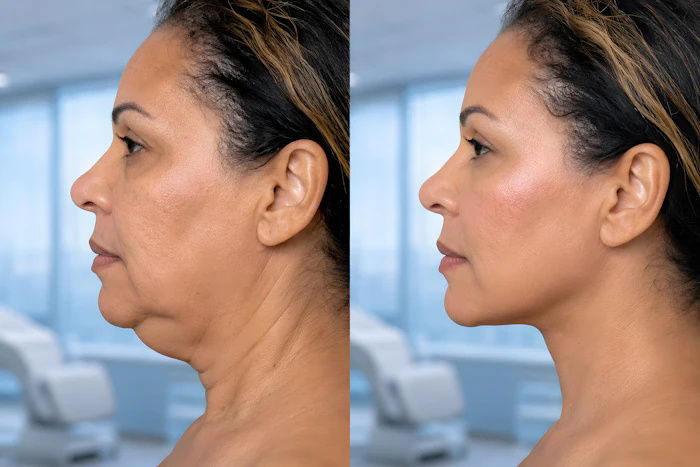
For nearly two decades, the conversation surrounding facelift surgery has steadily shifted toward the deep plane. That evolution has been important. By moving beyond skin tension and addressing deeper facial structures, deep plane surgery represented a significant advance over earlier techniques. But today, I believe the next evolution is not simply about whether a surgeon performs a deep-plane facelift. It is what is actually being restored once the deep plane has been entered. The distinction may seem subtle, but it fundamentally changes both the aesthetic result and the patient’s recovery.
Aging Is a Structural Problem
Facial aging is often described as skin laxity, volume loss, or the effects of gravity. While each contributes to the aging process, they are ultimately downstream effects of a more fundamental structural change.
The retaining ligaments of the face form the architectural framework that supports the facial soft tissues. Importantly, the deep origins of these ligaments, where they arise from bone and deep fascia, generally remain remarkably strong throughout life. They do not simply stretch out or fail.
Related: 10 Anti-Aging & Healthy Aging Treatment Trends [Survey Results]
Instead, it is the tissues suspended by these ligaments that progressively weaken. Over time, the delicate fibrous connections linking the retaining ligaments to the superficial musculoaponeurotic system, or SMAS, fat compartments, subcutaneous tissue, and skin gradually attenuate. Like the smaller branches of a tree bending under increasing weight while the trunk and roots remain firmly anchored, these supporting tissues elongate and lose their structural integrity. The result is descent of the facial soft tissues, not because the ligamentous roots have detached, but because the tissues they support have become increasingly compliant. This distinction has profound surgical implications.
Most facelift techniques focus on repositioning descended tissues after they have separated from their natural support system. During dissection, the retaining ligaments are frequently released or delaminated to mobilize the flap. Suspension is then achieved by placing tension on the SMAS or adjacent soft tissues. Our philosophy is fundamentally different.
Related: Understanding Intra-Individual Aging of the Facial Skeleton
If the retaining ligaments are meticulously identified, preserved, and incorporated into the suspension rather than weakened through unnecessary delamination, they become extraordinarily powerful structural anchors. Their dense collagenous architecture allows the surgeon to restore the entire composite facial unit to its youthful position through the same framework that originally supported the face. This transforms not only the position of the tissues but also the apparent distribution of facial volume.
Restoring the Root Rather Than Pulling the Branches
One analogy I often use is that of a tree. Pulling on the branches changes the position of the tree temporarily. Restoring the roots changes the entire structure.
The philosophy behind the MAERCKS Lift™ is to restore facial support where it originally existed: within the retaining ligament system itself. Through direct ligamentous suspension and preservation of the composite facial unit, the face is returned toward its native architecture rather than simply repositioned under tension.
This changes the visual outcome dramatically. Instead of emphasizing the lateral face, the procedure restores central facial support. Instead of creating the familiar lateral sweep sometimes associated with facelift surgery, it recreates youthful malar projection. Rather than relying on skin tension, the skin is allowed to redrape without meaningful tension. The objective is not a tighter face. It is a structurally younger face.
Structure Creates the Appearance of Volume
One of the most common misconceptions in facial rejuvenation is that aging is primarily a problem of volume deficiency. In reality, much of what patients perceive as volume loss is actually volume displacement.
As support diminishes, youthful upper facial volume migrates downward, creating hollowness in the midface and fullness along the jawline and neck. The upper face begins to appear depleted while the lower face becomes heavier. The temptation is to replace the missing volume with fillers or fat grafting. Often, however, the more elegant solution is to reposition the patient’s existing soft tissue back to its original anatomical location.
By restoring the composite tissues through their native ligamentous framework, this altered volume distribution can be converted back into a more aesthetic one. The cheeks regain projection, the jawline becomes defined, and youthful, heart shaped facial proportions reemerge, often without adding volume. Even the nose, lips, and eyes may appear more youthful despite receiving no direct intervention.
This is one of the most satisfying aspects of structural rejuvenation. The patient’s own anatomy creates the result. Rather than creating a different face, ligamentous restoration allows the patient’s anatomy to recreate the face they once had.
The Other Paradigm Shift: Recovery
Perhaps equally important has been rethinking the recovery experience itself. Patients have long accepted that major facial surgery must involve significant pain, narcotic use, and prolonged downtime. Our experience has suggested otherwise.
Using a comprehensive EXPAREL and Marcaine tumescent protocol, tissues are infiltrated before incision with a carefully designed solution that provides hydrodissection, hemostasis, and prolonged local analgesia. Rather than treating pain after surgery, the goal is to interrupt pain transmission before it begins. The majority of our patients require little or no opioid medication following surgery, and many describe remarkably little discomfort during recovery.
Equally important, preserving natural glide planes and minimizing unnecessary tissue trauma can significantly reduce swelling and bruising. Recovery becomes less about enduring surgery and more about allowing normal physiology to proceed.
Looking Forward
The future of facial rejuvenation will likely become increasingly anatomical. As our understanding of retaining ligaments, fascial relationships, lymphatic preservation, and facial biomechanics continues to evolve, the conversation will move beyond simply performing a deep plane facelift.
Instead, we will ask deeper questions: Which structures are being restored? Which vectors recreate youthful anatomy? How can recovery be minimized while preserving outcomes? These are the questions that continue to drive innovation.
For me, the most rewarding aspect of facial rejuvenation has never been making someone look different. It has been restoring facial harmony so naturally that friends notice someone looks healthier, happier, or more energetic without immediately recognizing that surgery has occurred.
That, ultimately, is the goal. Not redesign, but restoration. Not tension, but structure.