Before your next patient walks through the door, they have already formed opinions about what they want, what it should cost, and how long it will take. They have likely spent hours on Instagram and TikTok consuming before-and-after videos, comparing prices in comment sections, and watching an influencer describe a lip filler procedure as painless, affordable, and instantly transformative (with no mention of the additional treatments, products, swelling, or the six-month follow-up that produced the result they are admiring).
By the time they sit across from you, they are not a blank slate. They are a fully formed aesthetic consumer, shaped and “social media-educated” by content you did not create and may be inaccurate.
Related: Elevating Aesthetics: Why Ongoing Team Training Is Your Greatest ROI
This is the reality of today's aesthetic consultation, and practices that have not updated their approach are feeling it in their conversion rates, average patient spend, and the quality of their patient relationships.
What the Data Tells Us
Multiple studies published in the Aesthetic Surgery Journal confirm that between 40% - 60% of patients consult social media before a cosmetic procedure, and that visual platforms like Instagram have overtaken surgeon websites as the primary pre-consultation research tool. TikTok has since emerged as an equally dominant, and largely unregulated, source of procedural content.
The volume is significant. The hashtag #filler had accumulated 2.4 billion views on TikTok at the time of published analysis; #botox has tracked over 12 billion. Between 38% -54% of the videos behind those numbers were produced by non-medical creators, with measurably lower accuracy than provider-generated content.
What arrives in your consultation room is a patient who has done real research and absorbed a meaningful amount of misinformation. They came prepared. What they need is a trusted provider relationship.
Related: Unlocking Untapped Retail Revenue Potential in your Aesthetic Practice
The Consultation Has Become Transactional
Here is what I see consistently across the practices I work with: most consultation processes were not built for this patient. They were built for a patient who arrived with a general concern and deferred to clinical judgement. That patient still exists, but they are increasingly the exception.
The more common patient today arrives with a specific request, a reference image, and a price point from a comment section. When the provider responds with a single treatment and a single price, something damaging happens. The consultation becomes transactional rather than transformational.
A single-treatment consultation not only reduces revenue, but reduces expert positioning and the patient outcome. Without a strategy, vision, or a defined pathway, the patient is not choosing a treatment plan. They are deciding whether a number feels worth it. When they are not sure, they decide to shop around. This is how social media creates price shoppers.
What the Consultation Must Do Instead
The provider’s job during the consultation is not simply to assess and recommend. It is to close the expectation gap and replace the influencer's incomplete narrative with a clinical expert's complete treatment plan.
That requires a structured approach. At Terri Ross Consulting, we teach a proven consultation blueprint which becomes even more critical when a patient has arrived pre-loaded with social media-driven assumptions.
Assess Using the LAER Model
Before any recommendation is made, listen. The LAER model (Listen, Acknowledge, Educate, Respond) begins with a discipline most providers underestimate: silence. Listen 80% of the time. Ask only open-ended questions. Ask what has been bothering the patient most. Ask how this problem makes them feel and what improving it would do for them personally.
This matters especially for the social media patient, because what they say they want is rarely the whole story. "I want Botox" is often shorthand for, "I don't like how my wrinkles look on Zoom." Likewise, "I want my lips done like theirs" often means, "I don't think I look good" or "I'm insecure." The influencer content they consumed spoke to an emotion. If you do not uncover that emotion, you are selling procedures or services. If you do, you are solving problems. People pay to solve problems.
Educate to Position Authority
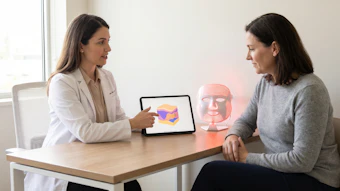
Once you understand the emotional driver, educate strategically. Explain what is actually occurring in the skin or tissue. Clarify what is really happening in the before-and-after image they saved. Articulate your clinical approach and unique value as a provider. You are not contradicting what they saw online. You are providing the expert layer that makes their actual result possible. Patients feel that distinction immediately.
- Develop the Treatment Plan
This is where most consultations collapse, and where the highest-performing practices differentiate themselves. Present the entire treatment plan that will deliver the best outcome. That is the provider's responsibility. Only if and when they can't afford it should you offer a phased approach: short-term correction, mid-term improvement, long-term plan and maintenance. Explain that aesthetic outcomes are built in steps, not delivered in a single appointment. One treatment may prepare the skin, another may create lift or correction, a third may improve skin quality, and a customized skincare regimen helps maintain the result. When patients see the full picture, they stop comparing your price to what they saw online. They understand they are investing in an outcome, in feeling more confident and the conversation shifts from "How much is it?" to "How do we get started?" Sequence the Treatments with Intention
Explain what comes first and why. What can be combined, and what must follow to achieve and protect the result. A patient who understands the sequence understands the value and stops asking why it costs more than what they saw online.
Integrate Skincare as Protocol, Not Add-On
In my experience working with practices across the world, the skincare conversation is the most consistently skipped and most consistently costly omission in the consultation. According to a study in Prime Journal, 86% of patients expect pre-treatment skincare guidance, but only 14% receive it. That is a 72% gap. And 91% expect a post-care regimen and only 30% are prescribed one.
Patients who receive a specific skincare recommendation from their provider are significantly more likely to purchase. Patients who don't, leave it to chance, buy elsewhere, or undermine their results with the wrong products. Skincare is not an optional add-on to discuss if time permits. It is part of the treatment plan, and leaving it out compromises outcomes, satisfaction, and retention.
- Establish the Follow-Up Before They Leave
Set the next appointment before the patient exits the treatment room. Reinforce the plan, the progress markers, and the next steps. A patient who leaves with a scheduled follow-up is a retained patient. A patient who leaves with only a business card is a potential price shopper.
The Language of Clinical Authority
Language matters enormously and even more so when recalibrating a patient whose expectations were set by a 60-second reel.
Phrases like "you could do this" or "if you want, you can" erode clinical authority. They signal uncertainty and transfer decision-making back to a patient who came to you precisely because they needed expert guidance.
The language of authority sounds different. "Based on your goals, here is the plan I recommend." "This is how we sequence treatments to achieve the results you are looking for." "Phase one focuses on correction. Phase two builds longevity." Confidence is not pressure; it’s leadership. It is what patients came to your practice to find and could not locate in a comment section on Instagram.
Turning Social Media Into a Pre-Education Channel
The same platforms generating misaligned expectations are also the most powerful pre-education tools available to aesthetic practices when used intentionally.
Practices creating transparent, education-forward content are not just building audiences. They are recalibrating their consultation pipeline before patients arrive. The recovery timeline video. The anatomy explainer. The honest 12-week follow-up video. This content does what influencer posts rarely do. It shows the clinical reality and positions the provider as the expert worth trusting before a single appointment is booked. Patients who arrive having consumed a provider's educational content convert at higher rates, raise fewer price objections, and are more receptive to comprehensive treatment planning.
Audit Your Consultation. Then Update It.
The social-media-informed patient is usually motivated, research-engaged, and emotionally invested, which is exactly the kind of patient aesthetic practices are built to serve. The question is whether your consultation process is structured to meet them where they are, redirect the narrative with clinical authority, and build a treatment plan and relationship that extends beyond the first appointment.
Examine your consultation process honestly. Review your conversion rates (high-performing practices should convert at 70%+), average transaction values, and the objections your team hears most often. Then ask whether your consultation process was designed for the patient of five years ago or the one arriving today, already shaped by social media expectations.
The practices that modernize their consultation process now will convert more patients, retain them longer, increase lifetime value, and create stronger patient relationships.