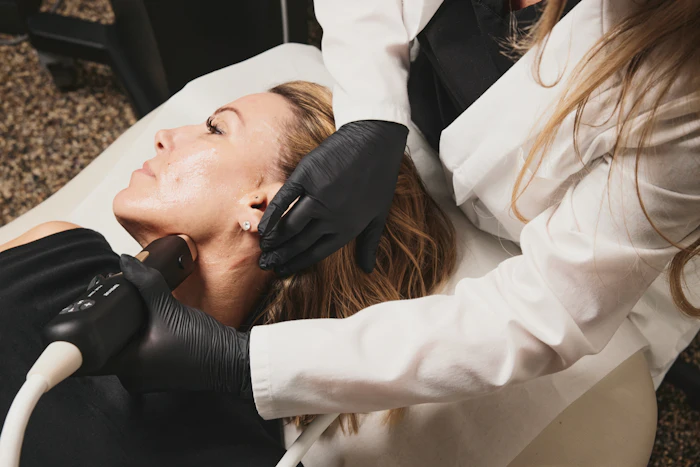
In honor of Menopause Awareness Month and World Menopause Day, which is observed annually on October 18, Jeisys Medical, the global aesthetics company behind DENSITY, announced its solution to changing the conversation surrounding the menopause collagen drop – a phenomenon where some women lose up to 30% of their skin’s collagen in the first five years of menopause, according to research.
DENSITY by Jeisys is an FDA-cleared, needle-free, non-invasive radiofrequency (RF) skin-tightening treatment that uses sequential monopolar and bipolar RF energy in a single pulse to target both deep and surface skin layers simultaneously.
Related: Menopause Goes Mainstream: A New Era of Aesthetic and Hormone Care
According to Jeisys, the dual-mode technology is designed to deliver energy to where collagen remodeling matters most, supporting immediate tightening while stimulating longer-term collagen remodeling.
“Women will often tell me, ‘I feel like my skin changed overnight,’” says board-certified dermatologist Dr. Lesley Clark-Loeser of Precision Skin & Body Institute in Davie, FL. “Of course it didn’t literally happen overnight, but estrogen plays an important role in collagen production, hydration, skin thickness and elasticity. There is a biological reason the change can suddenly become much more noticeable.”
For providers, the growing conversation around menopause and skin health raises important questions about when to intervene, what RF treatments can realistically accomplish and how to distinguish promising treatment concepts from established clinical evidence.
MedEsthetics spoke with Dr. David Shafer, MD, FACS, a double board-certified plastic surgeon at Shafer Clinic Fifth Avenue, and Dr. Lesley Clark-Loeser, MD, FAAD, co-founder of Precision Skin & Body Institute, about DENSITY’s potential role in collagen maintenance, the science behind dual-mode RF technology, patient selection and the evidence needed to support preventive aesthetic treatments.
1. Don’t Wait for the “Before” Photo
What clinical evidence supports using DENSITY specifically for menopause-related collagen loss? Are there published studies evaluating outcomes in perimenopausal or postmenopausal patients, or is the rationale based on broader research into RF and collagen remodeling?
 Dr. David Shafer, MD, FACS, Double Board-Certified Plastic Surgeon, Shafer Clinic Fifth AvenueKelz Media
This is relevant given the accelerated collagen loss that occurs with estrogen decline. Clinically, I have seen superior results with DENSITY alone or as an adjunct to traditional plastic surgery.
How does DENSITY compare with other RF treatments or established approaches to skin laxity in this patient population? What evidence supports its dual-mode technology offering a meaningful clinical advantage over existing devices?
Dr. David Shafer, MD, FACS: DENSITY’s sequential monopolar and bipolar delivery in a single pulse addresses multiple tissue depths at once, unlike traditional single-mode RF. This improves treatment efficiency while enhancing the overall outcome.
Preclinical data show greater collagen stimulation with the dual-mode approach, and clinical experience indicates good comfort, consistency and negligible downtime. For mild-to-moderate laxity or collagen maintenance, it is useful. For more advanced structural laxity, surgical procedures remain more effective. Combining both approaches is ideal.
2. Think Maintenance, Not Makeover
What does “collagen banking” mean in measurable clinical terms? How can providers distinguish preventive benefits from temporary tightening or improvements associated with treating existing skin laxity, and what data support intervening before visible changes appear?
 Dr. Lesley Clark-Loeser, MD, FAAD
Board-Certified Dermatologist
Co-Founder, Precision Skin & Body InstituteKelz Media
We know that estrogen plays an important role in maintaining dermal collagen, elasticity, hydration and overall skin quality. As estrogen levels decline, the skin undergoes meaningful structural changes, including diminished collagen synthesis and progressive deterioration of the extracellular matrix. Historical studies suggest that women may lose as much as 30% of dermal collagen during the first five years following menopause, although individual variability is considerable.
This creates a compelling rationale for earlier intervention, potentially before the clinical manifestations of collagen loss become pronounced.
Radiofrequency technologies, including DENSITY, utilize controlled thermal energy to stimulate tissue remodeling. We can see an immediate tightening response related to collagen contraction, followed by a more gradual biological response involving fibroblast activity, collagen remodeling and neocollagenesis over subsequent months.
From a clinical research perspective, I would define successful collagen support through objective measurements of dermal thickness, skin elasticity, firmness and architectural changes using standardized imaging, possibly ultrasound and/or biomechanical assessments, and, where appropriate, histological evaluation.
But there's an important distinction: demonstrating new collagen production or improved skin firmness is not the same as proving that we have prevented future collagen loss.
To truly validate the concept of collagen banking, we need prospective longitudinal studies comparing early intervention with delayed or no treatment, particularly in women transitioning through menopause.
I believe the opportunity lies in shifting our mindset from correcting visible aging to proactively supporting skin biology. Rather than waiting for structural deterioration to become clinically apparent, we may be able to intervene while the skin retains greater regenerative capacity.
The goal is not simply to tighten the skin we see today, but to optimize the biological environment that supports skin quality over time.
What are the limitations and risks of using RF treatments for skin tightening? Which patients may be poor candidates, what adverse effects should providers discuss, and how should treatment decisions account for differences in skin quality, age and menopausal status?
Dr. Lesley Clark-Loeser, MD, FAAD: Radiofrequency is an important tool in our aesthetic armamentarium, but it is not a universal solution for skin laxity. Successful outcomes begin with understanding what is actually contributing to a patient's appearance.
Skin aging is multifactorial. It involves collagen deterioration, loss of elasticity, changes in facial fat compartments, skeletal remodeling, photodamage and, particularly in menopausal women, hormone-associated changes in dermal structure and function.
Patient safety and appropriate selection are paramount. Important contraindications and treatment exclusions include implanted electronic devices such as cardiac pacemakers, defibrillators and certain neurostimulators; metallic implants or conductive foreign bodies within the treatment area; and active infection, open wounds or compromised skin at the intended treatment site. Pregnancy is also generally considered a reason to defer elective RF treatment because adequate safety data are lacking. These considerations should always be evaluated against the specific device manufacturer's guidelines.
Beyond these exclusions, I am particularly thoughtful when evaluating patients with thin skin, limited subcutaneous facial fat or significant facial volume depletion. Unintended thermal injury to subcutaneous tissue could adversely affect facial contours, making careful energy selection and treatment technique essential.
Patients with substantial redundant skin or advanced tissue descent are also unlikely to achieve the degree of improvement they may be seeking through nonsurgical RF treatment alone.
Although noninvasive RF treatments are generally well tolerated when performed appropriately, patients should understand the potential for transient discomfort, erythema, edema and tenderness. Less common but more consequential complications include burns, pigmentary changes, scarring, sensory alterations and unintended fat loss.
Device selection truly matters. DENSITY incorporates sequential monopolar and bipolar RF delivery with integrated epidermal cooling and impedance-based energy feedback, features designed to support controlled thermal delivery. However, these technologies do not eliminate the importance of patient selection, treatment technique and individualized energy settings.
Menopausal status should inform our approach, but it should not become a stand-alone determinant of treatment eligibility. Two women of identical chronological age may have dramatically different skin thickness, elasticity, photodamage, facial volume and regenerative potential.
I think we need to move beyond treating patients according to age alone and focus instead on their individual tissue characteristics and aesthetic goals.
The best aesthetic outcome isn't necessarily achieved by delivering more energy. It's achieved by delivering the appropriate stimulus to the right tissue, in the right patient.
3. Support the Skin, Don’t Change the Face
What should providers tell patients about the cost and longevity of results? Given that treatments start at $2,500, how long can patients reasonably expect benefits to last, what maintenance schedule is supported by evidence, and how should providers communicate the limits of what a treatment can achieve?
Dr. Lesley Clark-Loeser, MD, FAAD: When patients are investing $2,500 or more in a treatment, transparency about the magnitude, timeline and durability of the expected improvement is essential.
With radiofrequency treatments, I explain that there may be an initial tightening response, but meaningful biological remodeling develops progressively over the following weeks and months. For many patients, results become more appreciable around two to three months, with additional improvement potentially continuing beyond that interval.
Published studies of noninvasive monopolar RF support improvements in skin firmness and laxity lasting approximately six months, with some studies of RF platforms demonstrating benefits approaching a year or longer. However, the longevity of results varies with the specific device, treatment protocol, baseline skin characteristics, age-related changes and individual biology.
For newer technologies in the U.S., such as DENSITY, I would avoid promising a fixed duration because longer-term, device-specific durability data are still evolving.
From a maintenance perspective, an annual reassessment is reasonable, but that should not be confused with evidence that every patient requires treatment every 12 months. Maintenance should be determined by the individual's response, progression of skin aging and aesthetic goals rather than a predetermined schedule.
For women navigating menopause, I also emphasize that treatment exists within a continuously changing biological environment. RF may stimulate collagen remodeling, but it does not eliminate the hormonal, intrinsic or environmental influences that contribute to skin aging.
Consequently, a comprehensive treatment strategy may also incorporate daily photoprotection, evidence-based topical skincare and other appropriate interventions to address skin quality and structural changes that RF alone cannot correct.
Ultimately, I want patients to understand that these treatments offer an opportunity for meaningful, natural-looking improvement, particularly in appropriately selected patients with early-to-moderate laxity. They are not substitutes for surgical lifting, nor do they permanently halt collagen decline.
The procedure initiates a regenerative response, but the patient's biology determines how that response evolves and how long the benefit is maintained.
I believe that when we frame aesthetic treatments in terms of supporting skin quality and healthy aging, rather than promising to reverse time, we create more realistic expectations and more meaningful long-term patient relationships.