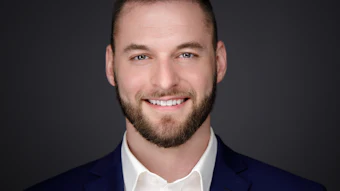
!['[W]hen a perfumer is given a brief, you're taking parts from different parts of your life and experiences, you're bringing such a personal POV to create an olfactive experience that can't be replicated by a computer that doesn't have those touchpoints,' says perfumer Nicole Mancini.](https://img.medestheticsmag.com/mindful/allured/workspaces/default/uploads/2026/03/img-7063.PH7aX8fPat.jpg?auto=format%2Ccompress&q=70&w=700)
The art of perfumery has long been a dance between technical precision and raw, human emotion. As the industry stands at the intersection of traditional craft and emerging AI, the World Perfumery Congress (WPC) is set to host a unique panel that reaffirms a vital truth: no technology can replace the distinctive mind of a creator.
Moderated by Perfume Room host Emma Vernon, this session brings the podcast’s beloved "What’s That Smell?" segment to the global stage. Among the featured noses is Nicole Mancini, principal perfumer at dsm-firmenich, who will join fellow perfumers to pull back the curtain on how the industry's most brilliant minds interpret the intangible.
In this exclusive Q&A, Mancini highlights the irreplaceable nature of human creative intuition in perfumery, viewing AI not as a threat but as an efficient tool for mundane technical tasks. Mancini emphasizes her unique American perspective, rooted in an East Coast upbringing and a background in psychology and biochemistry rather than a traditional European pedigree, which allows her to approach abstract briefs with liberating, non-traditional ideas.
Her technical expertise, honed in consumer products and difficult chemical bases, provides a competitive edge in creating structured, high-performance fragrances across multiple formats, from fine perfumes to home scents. Ultimately, she underscores resilience as the most vital skill for the next generation, advising young perfumers to separate their personal identity from their art to navigate the rigorous, subjective nature of client feedback and the long road to a final product.
The upcoming panel emphasizes that technology will never replace the human mind in perfumery. How do you personally protect that creative intuition while working alongside the industry's new high-tech tools?
Mancini: For me it's not a top-of-mind type feeling that perfumers, or people in my profession, will be replaced. I think of AI as an exciting tool to do a lot of the work that we have to do that's not so fun and sexy—like CMR replacements and other kinds of modifications that take time away from creativity.
For me, when a perfumer is given a brief, you're taking parts from different parts of your life and experiences, you're bringing such a personal POV to create an olfactive experience that can't be replicated by a computer that doesn't have those touchpoints. What we do is emotive and it brings those out in others. It is not something I do consciously to protect it and I don't think about AI other than being excited to use it as a tool for other parts of the job.
When you first heard AI being utilized, of course it's every person's fear to be replaced, but I think now seeing how companies are using it, it's like, “oh, can I get to where I wanna get faster” or to be utilized for a suggestion of something that wouldn't be in my normal wheelhouse.
Your academic background is in psychology and biochemistry. How does your understanding of the human mind influence the way you 'anchor' people in their surroundings or foster a sense of belonging through environmental fragrance?
Mancini: I was surprised how much my psych degree has helped me relate to and understand people and take a bird’s-eye view of someone’s expectations or what they want. It’s been really helpful.
Environmental fragrance, for me, is part of the overall fragrance experience. That’s something I really find important. For example, my home has a certain feel and each room is different. I want people to come in and feel like they’re being invited somewhere, a place they want to linger in, cocooned in the scent.
Signature-wise, I like to have an aspect of a fragrance that envelops you. Musks, I like to use to open or end a fragrance with, because they have that cocooning coziness and feel like an invisible hug—who wouldn’t want that?
By season, I like changing the tones—warmer, more floral, fresh creations. For the holidays, warm woods and spices. In the summertime, tropical, watery fresh notes and tropical fruits.
From a psych perspective, I start with myself—what do I want to smell, what do I want the feeling to be, and how do I want others to feel in that space?
 "What separates me and makes me different is not having that traditional, formal education in perfumery, and instead coming at it from the perspective of my East Coast upbringing," says Mancini. "I have ideas that aren’t traditional or steeped in a set of rules that predated me. What you don’t know, you don’t know."dsm-firmenich
As one of the few American women to achieve the rank of principal perfumer in fine fragrance, what unique American perspective do you bring to your formulations that sets them apart from the traditional European school of thought?
Mancini: I think it’s just that. My schooling here was obviously very different from Europe, where if you know you want to be a perfumer, you go to places like ISIPCA and follow that legacy path. For me, it was much more happenstance, something that came about by chance.
What separates me and makes me different is not having that traditional, formal education in perfumery, and instead coming at it from the perspective of my East Coast upbringing. I have ideas that aren’t traditional or steeped in a set of rules that predated me. What you don’t know, you don’t know.
I walked into my first fragrance house at 22, my friend got me a temp job there. It was shocking to me to realize that Calvin Klein didn’t actually make Calvin Klein.
It really was kismet. Not having that pedigree or background can make it harder to break in, but I also think it can be beautiful and liberating.
You began your technical mastery in consumer products like air care before transitioning into prestige fine fragrance. How did working with functional chemical bases prepare you for your current role?
Mancini: I think that right now my clients, both specialty and prestige, are transitioning into multiple formats. That’s interesting because you want to maintain strength, but you also need to think about different dosages. You have to know what’s strong but still beautiful, and what will work in alcohol.
When I was working in consumer fragrances, you had lower cost constraints and more difficult bases that could suppress or change fragrance notes. You were always competing with the base, and that gave me an understanding of how to look at materials not just for their beauty or how they make me feel, but for what they can actually do for me. It made me think about things in a different, more structural way, focusing on strong performance and working with the hedonics.
A lot of these prestige or fine fragrance brands now have large line extensions like candles and lotions, and other clients coming up through Sephora are experimenting with different formats. I’m able to understand what’s happening both in the fragrance and in the base and fix problems as they come up.
That’s a competitive edge that others may not have. I also still love creating for the home as well as personal fragrance. It keeps things exciting for me.
You've described your compositions as being thoughtfully constructed as a well-designed space. When approaching a new brief, do you visualize the architecture and design of a space before you begin selecting the raw materials and molecules?
Mancini: For sure, I always have somebody in mind. Whenever I get a brief, I build a sensorial list: What’s the color? Is there a mood board? What’s the packaging? What’s the sound, the playlist? What’s the mood, the feeling? Is it silky, furry, cozy, fresh? I try to think about all the other sensory elements.
If it’s something I’m creating for the home, I think about a space. Is it a downtown loft, the suburbs, the heat of Texas? What’s the vibe? Because that changes how I create.
For perfume, I’m thinking about the person. What are they wearing? What are they into?
The question is always, what’s the vibe? It all has to fit together.
Your career was influenced by a trailblazing mother who broke barriers in finance. As you shape the future of this industry, what is the most important lesson you pass on to the next generation of perfumers?
Mancini: One of my greatest joys is being a mentor to up-and-coming perfumers, especially young women. I came up in a different time, and I’m happy to be someone who is ultra-supportive but also very direct – trying to help them get where they need to be faster. Everything moves so quickly now, so they need to be ready and prepared.
It can be tough when you’re younger and getting critiqued. My advice is not to take criticism personally. Separate your creation, your art, from yourself. Perfume is a very human and subjective thing. Whether it’s your design manager or your customer, you can get ruthless feedback. My approach is to step back, look at it differently, put it down, and come back. The best way to handle it is to give it everything you’ve got, come up with 10 ideas, and turn that “no” into a “yes.”
Resilience is the biggest skill for a young perfumer, or any perfumer, not creativity. You hear “no” more times than “yes,” and you see it on the shelves. It’s a long road. When you see a fragrance on the shelf, the amount of work it took to get it into that bottle is unfathomable.
I’m creating for my client, and there’s a piece of me in there, but ultimately I’m creating for my client’s customer. What do I want them to feel when they smell and wear the fragrance? That’s the mindset I try to keep. We get evaluations back, and sometimes people aren’t satisfied yet but I see it as a fun challenge, a game: how do I get to “yes”? It should fuel you, not deter you. It’s not easy, but I make that my mindset.