A new laser arrives at your medspa, and the rollout moves quickly. Your team completes the manufacturer’s training, learns the treatment settings and starts booking patients. From the outside, the practice looks ready.
But behind the treatment-room door, important questions may still be unanswered. Who oversees laser safety from day to day? Is the protective eyewear appropriate for that device’s wavelength? Where are the written procedures? And what happens if there is an accidental exposure, burn, fire or equipment malfunction?
Related: Aspen Laser Systems & Laser Safety Certification Create Training and Certification System
The space between knowing how to operate a device and having a complete safety system behind it is the laser safety compliance gap—easy to overlook in a busy practice and often where preventable risk begins.
One of the most common gaps we encounter in training is not technical skill, but unclear responsibility for the laser safety program.
Operating the Device Is Only the Beginning
Manufacturer education is essential, but it generally focuses on operating equipment and performing treatments. A laser safety program is broader, covering the treatment environment, staff responsibilities, hazard controls, documentation and emergency response.
Related: Practice Management: Top Compliance Concerns
Class 3B and Class 4 laser systems can cause serious eye and skin injuries. Class 4 systems may also create reflected-beam and fire risks. Those hazards require controls around the room, the equipment and everyone who enters the treatment area.
Energy-based devices should not be treated as though they are all the same. Intense pulsed light, radiofrequency and ultrasound are different technologies, each with its own hazards, operating considerations and manufacturer instructions. A well-run practice inventories each device separately and builds procedures around the technology being used.
ANSI Z136.3: Your Framework, Not Your Only Rulebook
ANSI Z136.3, Safe Use of Lasers in Health Care, is a widely recognized consensus standard for laser safety in healthcare settings. The 2024 edition provides a framework for cosmetic, diagnostic, therapeutic and preventive laser use, including hazard evaluation, controlled areas, protective eyewear, staff education, equipment maintenance and incident response.
ANSI standards are voluntary consensus standards, not OSHA regulations by themselves. OSHA does, however, identify the ANSI Z136 series as a source of guidance for protecting workers from laser hazards.
No single checklist covers every requirement. Federal product rules, workplace-safety obligations, state scope-of-practice laws, facility requirements, manufacturer instructions and insurance conditions may all apply. State rules may also address operator credentials, medical supervision, delegation, facility registration or written treatment protocols.
ANSI Z136.3 provides a strong framework, but every practice must still verify the requirements governing its location, services and staff.
The LSO Is a Job, Not a Certificate
A Laser Safety Officer, or LSO, oversees the facility’s laser safety program and helps ensure that known hazards are identified and controlled. In a smaller practice, the role may be assigned to a qualified team member. Larger organizations may require oversight across several rooms, devices or locations.
Responsibilities may include maintaining the device inventory, establishing laser-controlled areas, confirming that protective eyewear matches the wavelength and required optical density, developing written procedures, coordinating staff education, reviewing maintenance records and investigating suspected exposures or incidents.
The position must also come with authority. An LSO who identifies an unsafe condition needs to be able to pause treatment until the issue is corrected.
A medical director may serve as the LSO when properly trained and formally assigned, but the roles are not automatically interchangeable. Medical oversight and laser-safety oversight involve different responsibilities, even when one qualified person performs both.
The same principle applies to vendors. Equipment representatives and outside trainers can be valuable resources, but they do not manage your daily safety program. Once training ends, the facility still needs its own policies, oversight and documentation.
“Patients assume that any practice using a laser has a real safety program behind it,” says Stephen Fink, DO, FAOCO, a board-certified facial plastic surgeon. “A trained Laser Safety Officer isn’t a formality—it protects the patient, the staff and the practice itself.”
How Small Gaps Become Big Liabilities
Laser-safety problems rarely begin as dramatic failures. More often, they start as small inconsistencies.
One employee checks the eyewear label; another reaches for the pair that looks familiar. One room posts the warning sign only during treatment; another leaves it up around the clock. Maintenance is completed, but no one can quickly locate the service record.
These gaps matter when you are hiring, adding equipment, opening another location, renewing insurance, responding to an employee injury or facing a licensing inquiry. Documentation will not prevent every adverse event, but it can show that your practice recognized known hazards, trained its team and created a reasonable system to manage them.
Six Steps to Close the Gap
- Build a complete device inventory. Record the manufacturer, model, serial number, technology, wavelength or energy type, hazard classification and service history for every laser and energy-based device. Follow the manufacturer’s maintenance schedule, document repairs and confirm that equipment is safe before returning it to service.
- Verify state law and scope of practice. Rules may address licensing, delegation, supervision, facility registration, operator training and written protocols. A course certificate or manufacturer training does not expand a provider’s legal scope of practice.
- Formally designate a qualified LSO. Put the assignment in writing. Make sure the person understands your devices, has appropriate laser-safety education and can stop unsafe activity.
- Write device-specific procedures. Do not rely on one broad policy for every machine. Address setup, access control, eyewear, pre-treatment checks, emergency shutdown, fire precautions, maintenance, incident reporting and plume control when applicable. Where appropriate, keep a current, device-specific quick-reference protocol at the point of use to reduce setup and parameter-selection errors.
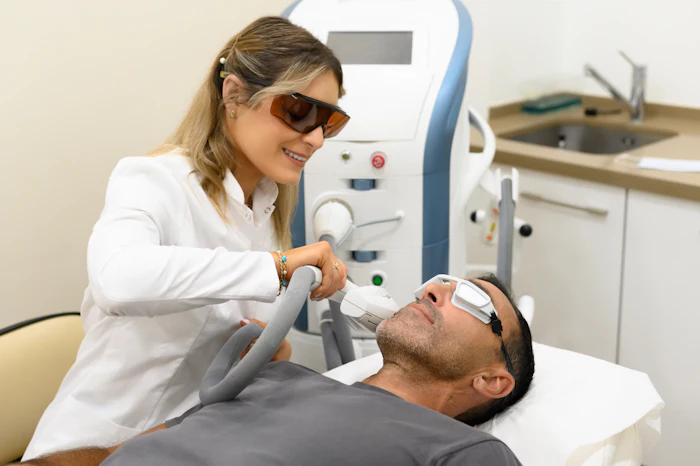
- Audit each treatment room. Confirm that protective eyewear matches the device’s wavelength and required optical density, warning signs are used correctly, access is controlled, emergency controls are accessible and fire precautions are in place. Keep flammable products and materials away from the treatment area, and ensure appropriate fire-response equipment is readily accessible. Eyewear should never be selected by tint or appearance alone.
- Train, document and reassess. Anyone who operates lasers or enters a controlled area should understand eye and skin hazards, room controls, emergency shutdown, fire risk and incident reporting. Record the date, topic and participants for each training session, and review the program whenever devices, staffing or locations change.
Build the Program Before You Need It
Energy-based treatments can support a med spa’s clinical and financial growth, but every new device brings responsibilities beyond treatment settings and technique.
A strong laser safety program does not need to create unnecessary bureaucracy. It should create clarity: who is responsible, which procedures must be followed, how staff are trained and where important records can be found.
The question is no longer simply whether your team knows how to operate a laser. It is whether your practice has built the safety infrastructure needed to support that technology responsibly.