Perfect Corp, which is an AI and augmented reality beauty-tech platform for retail and aesthetic businesses, released a report examining consumer expectations around treatments and consultations on May 12, 2026.
After surveying 300 consumers and data from Spate’s Popularity Index regarding modern aesthetic trends, Perfect Corp found evidence of the mainstream's shift to aesthetics, backing other research pointing to the industry's pivot to "natrual", "non-invasive" procedures.
Related: Holistic Aesthetics and the Shift Toward Facial Harmony

According to the report, aesthetic procedures like Botox and fillers have become mainstream, with 80% of surveyed consumers expressing sentiments towards the procedures.
- Engagement: 45% of respondents have received a procedure, while 44% are actively considering one.
- Motivation: Consumers view these treatments as a proactive self-care strategy to prevent aging, improve skin quality, and boost confidence.
Similarly, there has been rise in the desire for natural results, long-term skin health and "undetectable" aesthetic results.
- Longevity Trends: Year-over-year search growth includes Age Management (+151.6%), Skin Barrier (+41.1%), Cellular Senescence (+35.6%), and Skin Microbiome (+34.1%).
- Natural Enhancement: Consumers prioritize subtle improvements over dramatic changes. Concerns about looking unnatural and safety lead to a high preference for treatments like Microtox (+859.7%), Facial Balancing (+121.5%), and Non-Invasive Face Lifts (+72.6%).


One of the most intetrsting findings has been patients' response to AI in consultations, as their research shows AI-powered visualization is essential for building consumer confidence and trust.
- Consumer Impact: 84% of consumers believe AI result previews would increase their confidence in trying a procedure, and 87% believe it would increase trust in their provider.
- Expert Utility: AI simulations bridge the gap between patient expectations and provider recommendations, creating a "shared roadmap" for treatment.
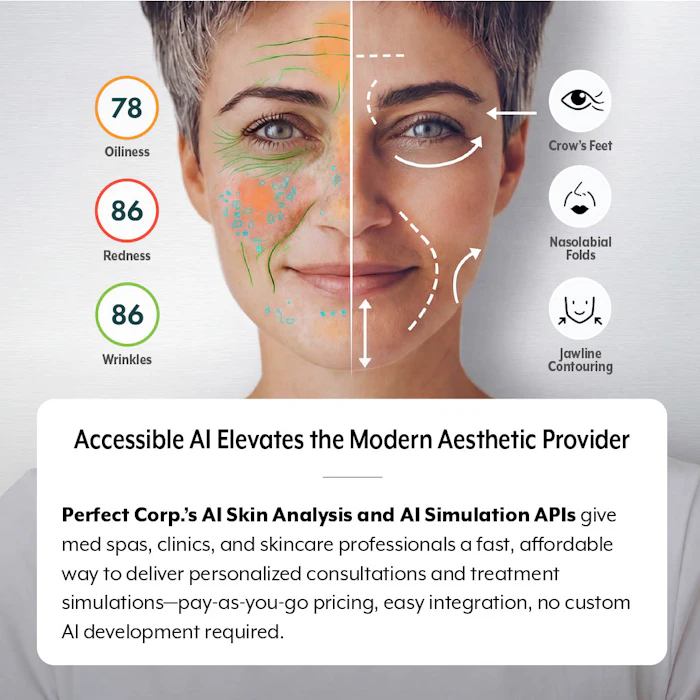
- Provider Accessibility: Perfect Corp. offers AI Skin Analysis and Simulation APIs that allow professionals to provide personalized, transparent consultations without the need for custom AI development.
As aesthetics increasingly intersects with wellness, prevention, and long-term skin health, consumer expectations are rapidly evolving. Patients are becoming more educated, more cautious, and more focused on maintenance over dramatic transformation — a shift that is also accelerating interest in AI-powered consultations, predictive imaging, and personalized treatment planning.
In a conversation with MedEsthetics, Perfect Corp. Co-Founder, Chief Growth Officer, and US President, Wayne Liu discussed how emerging technologies and changing consumer mindsets are reshaping the future of medical aesthetics, from “age management” and longevity-focused care to the growing role of artificial intelligence in patient trust and decision-making.
MedEsthetics: To start, can you explain why consumers are shifting away from “anti-aging” language toward concepts like longevity and maintenance? How do you describe that shift?
Wayne Liu: “We’re seeing consumers — especially Gen Z, millennials — increasingly view aesthetics as part of overall wellness and long-term skin health, instead of just focusing on aging”
Wayne Liu: “That’s why in this report, we see the search for age management increase by over 150%.”
MedEsthetics: Let’s talk about AI. Why do AI-generated treatment previews work so well for building trust and confidence among patients? And is this technology at a stage where it’s essentially a “must-have” for medspas and physicians?
Wayne Liu: “AI actually is not new; the term emerged back in 1950. We started using AI 11 years ago — especially in virtual try-ons using computer vision. And then, for skincare specifically, we’ve been developing AI-powered skin analysis for six or seven years.”
Wayne Liu: “We were heavily using predictive AI, which collects data. For example, we have around 500,000 skin data: In our case, it’s high-definition, highly curated photos.
Wayne Liu: “So we have photo, then we identify which problem it is, then we put it into the AI trainer. So our AI acts more like a dermatologist.”
Wayne Liu: "In essence, using AI is really helpful because customers want certainty before coming into a treatment, especially the big treatment– financial wise – and then also it may change their life forever. So that's why they want to see something before they really commit, just like when you go to buy a house, you'll probably see someone first.”
MedEsthetics: As consumers become more cautious, educated, and longevity-focused, how should providers adapt? What practical advice would you give practitioners who want to serve this new generation of esthetic patients?
Wayne Liu: “First is for the practitioner provider, first is you need to assess. You need to do a very honest assessment of your current process. Then figure out which part of your process, for example, consultation, reservation, customer service, follow up, which part of this are winning cases if you're using AI. Then you start to do a verification, find the good vendors. And then you find the cases, like a POC, you do small cases, and then make sure you have a good measurement, like a matrix. So it's a process, it's not like you just buy an AI and use it. “You really need to be transparent about your practice, okay? Especially finding the good vendors to help protect your clients' data, that's important, and you need to make sure the client is aware you are using AI.”
Read the full report on here.