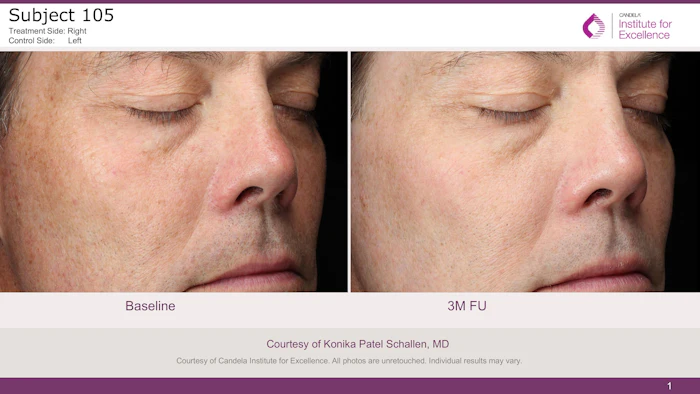
On June 30, Scientific Reports (Nature Portfolio) published a new peer-reviewed study providing the first live human testing evidencing that Candela's Nordlys 1940 nm non-ablative fractional laser can modulate the skin's epigenetic signature —reversing nearly 84% of age-associated epigenetic changes observed in responsive sites over six months.
Conducted in partnership with Mitra Bio and the Candela Institute for Excellence (CIE), the research and education arm of Candela, the new study shows how Candela’s Nordlys 1940 nm non-ablative fractional laser reverses age-associated DNA methylation at the majority of responsive sites.
Related: Candela Corporation Unveils Glacē Solution, Inspired by K-Beauty Trend for 'Glass Skin’
The groundbreaking research is especially significant in that it pushes the conversation of collagen stimulation and wrinkles into the realm of regenerative aesthetics, as researchers have now proved that lasers can induce durable changes in DNA methylation.
The study split-faced 22 adults, where researchers profiled more than 3.8 million CpG sites (cytosine-phosphate-guanine rich regions in the genome where epigenetic switches are regulated) per sample across nine months. At 83.9% of sites associated with skin aging, the treatment shifted DNA methylation patterns, indicating signs of biological age reversal at the molecular level. The changes were progressive and durable: 635 differentially methylated regions emerged one month post treatment series, expanded through three months, and were present and stabilizing at six months.
The changes were progressive and durable: 635 differentially methylated regions emerged one month post treatment series, expanded through three months, and were present and stabilizing at six months.
“This study is an important first step toward understanding the biology beneath what we observe in the clinic,” said Konika Patel Schallen, MD, lead author and SVP of Global Clinical Operations, Candela. “Physicians have seen that Nordlys treatments do more than improve the skin’s appearance and until now, we could not fully explain why. For the first time, we have evidence of the molecular mechanism behind why skin is healthier and appears more youthful. Importantly, it also points to a molecular link to skin cancer biology and supports prior studies that link to lower keratinocyte-carcinoma risk.”
“Epigenetic patterns are among the most reliable molecular markers for measuring aging. By profiling more than 3.8 million sites across the genome, we found that the changes were not only directional, opposing the patterns we associate with aging, but also durable and strengthening over months. That combination is what makes these results scientifically compelling,” said Dr. Cristiana Banila, Chief Scientific Officer and co-founder of Mitra Bio, who was a co-author of the study.
Geoff Crouse, Chief Executive Officer of Candela, said, “Candela’s long-time industry leadership is driven by a commitment to science-based innovation. For decades, the industry has measured treatment success by the visible treatment impact. This research quantifies visible improvements and demonstrates the impact of the Nordlys system on skin biology. We are proud Candela continues to lead the conversation beyond the cosmetic realm and into regenerative medicine, skin health, and longevity.”