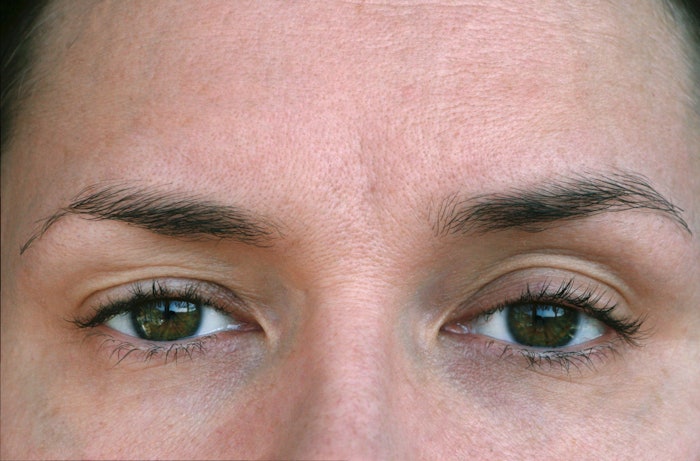
Kian Eftekhari, MD, a board-certified oculofacial plastic surgeon in Utah, has been selected to present at the 18th American-Brazilian Aesthetic Meeting on Feb. 5-8 in Park City, Utah. He was chosen to attend this meeting to educate an international audience of plastic surgeons from the United States, Brazil and more than 60 countries worldwide about a five-minute ptosis operation.
 Eftekhari will present a five-minute ptosis surgery technique at the 18th American-Brazilian Aesthetic Meeting, educating an international audience of plastic surgeons on a highly effective procedure for correcting droopy eyelids.Courtesy of Dec. 5 Eyelid Center of Utah Press Release
Ptosis can be caused by various factors, including age-related tissue weakening, muscle dysfunction, nerve damage or congenital issues [1]. Upper eyelid ptosis correction is a technically challenging operation, and outcomes with standard methods can be unpredictable, with revision rates reported between 8.7% and 18% [2].
Ptosis is the second most common surgery Eftekhari performs at the Eyelid Center of Utah, after upper eyelid blepharoplasty. According to his center’s website, Eftekhari relies on three techniques when performing ptosis surgery. The first is the Mullerectomy procedure [1]. Eftekhari reaches the eyelid-lifting tendon from the inside of the upper eyelid, then carefully tightens and secures it so the eyelid lifts properly—all without making any incision [1].
Levator Advancement Ptosis Repair is the second procedure, involving an incision in the natural eyelid crease and repairing the tendon of the upper eyelid that has stretched [1]. This is called the aponeurotic approach to upper eyelid ptosis surgery, and Eftekhari learned this procedure from Richard Anderson, MD, the website stated. Levator advancement is the most commonly used technique by plastic surgeons for upper eyelid ptosis correction [2].
Lastly, Frontalis Sling Ptosis Repair, according to the site, is used mainly in children who are born with a severe congenitally droopy eyelid. Eftekhari connects the upper eyelid tendon to the forehead muscle to help open the eye [1].
Eftekhari studied and trained at Stanford University and the University of Pennsylvania, and is an active member of American Society of Ophthalmic Plastic and Reconstructive Surgery, where he is a recipient of its Outstanding Contribution Award. He is also a multi-year Castle Connolly Top Doctor who lectures nationally and internationally on eyelid and facial surgery, per a Dec. 5 press release.
References:
1- https://eyelidcenterutah.com/upper-eyelid-ptosis-surgery/
2-https://journals.lww.com/plasreconsurg/fulltext/2024/06000/upper_eyelid_ptosis_correction_with_levator.42.aspx