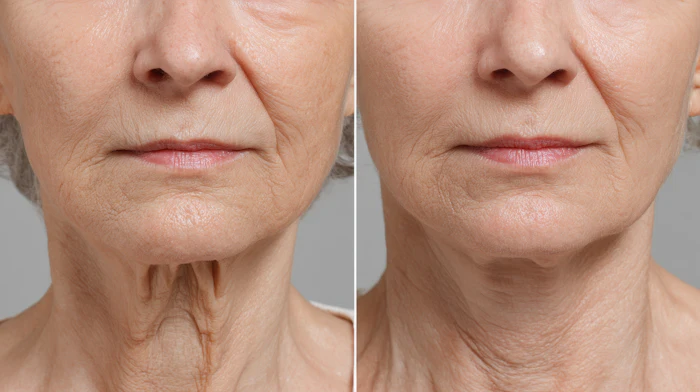
"Slipping" is a term that's been buzzing in the world of facial plastic surgery recently that refers to a facelift that appears to have lose its initial tightness.
Allure ran a piece in April titled Kris Jenner's Facelift is Apparently Now Slipping, with side-by-side photos of the famed reality star right after her reported procedure with famed surgeon Dr. Steven Levine in May of 2025 and of her red carpet appearance at the 2026 Vanity Fair Oscars Party in March of 2026. The "frenzy" surrounding Jenner's appearance was "impossible to ignore," as she was unhappy and looking for a revision, the article reads.
Jenner, however, didn't create the term or the new distorted expectations from facelifts, as much as she catapulted it into mainstream beauty discourse.
A recent feature in PBL Magazine quotes plastic surgeon Dr. Roberto Viel, who is the leading plastic surgeon at Dr. Roberto Viel Aesthetics, saying that "facelift slipping" is "largely a media-driven term rather than a medically recognized diagnosis." Similarly, a 2025 study by PubMed examined facelift before-and-after photos on social media and found concerns about potentially misleading imagery.
"Slipping" in Reality
So so facelifts slip? The short answer is no. Much like Dr. Viel said, what patients are casual observers are witnessing is a misguided perception of facelift surgery outcomes. "This does not mean the surgery has failed, but rather that the initial tightness and dramatic post-operative result can soften over time as swelling subsides and the tissues settle,"Dr. Viel said.
Dr. Carl Truesdale of Truesdale Plastic Surgery tells People Magazine what people are misidentifying is really post-operation swelling and that the results are settling in. Similarly, Dr. Krishna Vyas, of Blechman Plastic Surgery, tells People Magazine that the term can be favorably used to "sensationalize what may simply be a normal part of the healing process," adding that "true early relapses occur in roughly 2 to 3 percent of cases within the first two years."
Related: Details on the Deep Plane Facelift from Philip Robb Jr., M.D.
Honeymoon Stage
The "healing process" Dr. Vyas is referring to even has its own term in the facial plastic surgery world: The Honeymoon Stage. The term refers to the first days and weeks after surgery.
Swelling, inflammation, and tissue compression can create an unusually tight, lifted look — like how Kris Jenner looked after her alleged procedure last May. "This does not mean the surgery has failed, but rather that the initial tightness and dramatic post-operative result can soften over time as swelling subsides and the tissues settle," Dr Viel said to PBL magazine.
As swelling resolves over the following weeks and months, the face begins to soften and settle. This natural transition can be misinterpreted by patients and the general public at large— especially in the age of social media—as loss of correction or surgical failure. In reality, facial plastic surgeons emphasize that facelift results continue to evolve for several months as swelling resolves, tissues settle, and internal scar maturation progresses.
As facelift techniques evolve, so does the language used to describe their results. But surgeons are increasingly clear: what is often labeled online as “slipping” is, in most cases, not a complication—but a timing issue between early postoperative appearance and final healing.